
Technology Aversion Again

Technology Aversion Again
This week, the internet in our home was off and on for two days. I missed a total of three meetings—two of which were being recorded. Knowing that I could rewatch the two meetings didn’t do much for my impatience. When we lose the internet, we also lose the ability to use our cell phones. Because of the service provider and where we live, running off data doesn’t exist.
During our Shrove Tuesday pancake dinner at church, I tell Mike that we are without the internet again.
“I called our wireless provider this morning and told them about what happened the night before and that I work from home and need the internet for work. A service man arrived within fifteen minutes. He mumbled some things when he checked our modem and extender. And then he left to check our line at the street. A few minutes later the internet went out again.”
“I’m so sorry, Steph,” Mike says.
“When I left the house, there were multiple cherry pickers and other trucks in our neighborhood working on a line. I was told it had to do with a dump truck taking out one of the lines. None of it makes sense to me and I don’t want to feel as frustrated as I feel. In the scheme of life, not having the internet shouldn’t be such a big deal.”
“We depend on it.”
“I know and that’s what bothers me.”
I read George Orwell’s book 1984 in high school in 1979. It freaked me out. And then there was Aldous Huxley’s book Brave New World…In 1983, the song “Mr. Roboto” cemented the final layer of fear. Computers are bad. They will dehumanize us. I will never have a computer. I won’t let go of my humanness and will turn my back on the age of technology. It will pass.
According to Wikipedia, we are in the Technological Revolution, which began in the 2020s. Prior to that, there were three other stages—1) the technical revolution aka second industrial revolution (1870-1920), 2) the scientific-technical revolution (1940-1970), and 3) the digital revolution or third industrial revolution (1971-2020). To me, the technological age began when I read the abovementioned books. I set my sights on staying grounded and averse to the progress barreling down on me.
In 1982, when I was almost twenty years old, I was a member of the governing body at my large church, known as the vestry. I was the only female and by far the youngest. There were twelve of us on the vestry, in addition to our priest: all males, ranging from lawyers to business owners. Talk began about getting a computer for our church. It became a hot topic for me. So much so, I made it a practice to take a bathroom break or go sip some water from the water fountain down the hall during those discussions. My emotions were in fierce opposition to this change.
Words from 1984 ran across my mind: “Oceanians live in a constant state of being monitored by the Party, through the use of advanced, invasive technology. They are used to living in a constant state of surveillance— either through technology or police patrol.”
And from the Brave New World: “Call it the fault of civilization. God isn’t compatible with machinery and scientific medicine and universal happiness. You must make your choice. Our civilization has chosen machinery and medicine and happiness.”
I’m thankful not to have seen “2001: A Space Odyssey,” during this time. I doubt I would have had the wherewithal to step away from the discussion.
Instead, one day I confronted my priest after church.
“I need to talk with you.”
“Okay. Wait in my office and I will be in there in a few minutes.”
I waited, not sure how I was going to tell him my plans if we chose to buy a computer for the office.
“What’s going on?”
My words came out of my mouth with such force I was taken aback.
“If the vestry approves the purchase of a computer and you find it smashed to bits one day you will know who did it.”
Dr. Curtis takes a deep breath and looks straight at me.
“Steph, I think your feelings about technology are not all about technology. I think there are other emotions you need to sort through with therapy. I have someone I can recommend.”
I did not expect that response. But I trusted him and acquiesced to his suggestion. The beginning of my life of therapy started right then. In the end, though, I’ve still harbored concern about our dependency on technology as if it’s on the bottom rung of Abraham Maslow’s hierarchy of needs—along with oxygen, air, water, food, rest, etc.
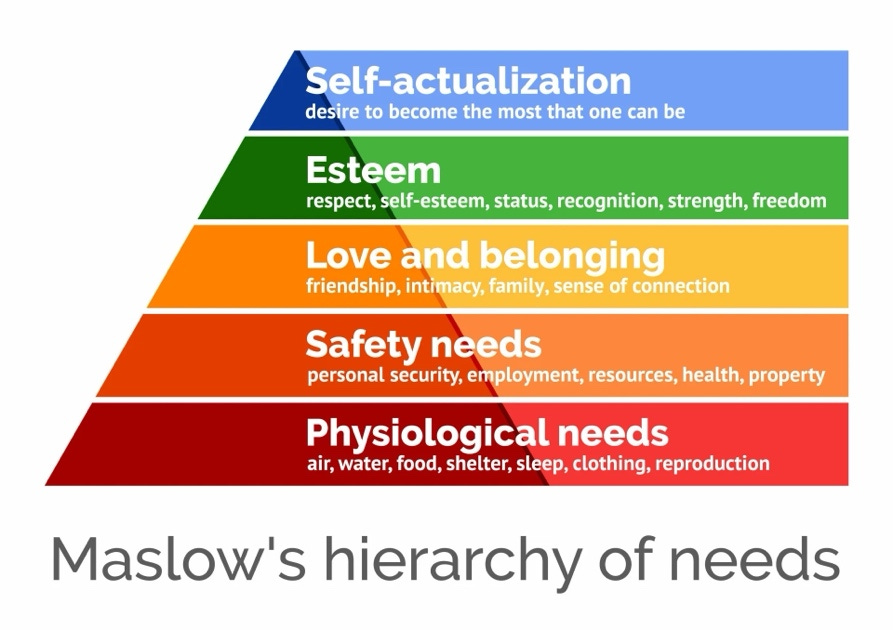
I want to know where it ranks on the chart in my life. My level of frustration makes me think it’s down there near the physiological needs. And there’s the rub. Looking at the chart, I believe it crosses between “love and belonging” and “safety needs.” The computer allows me to work from home and it offers a sense of connection. Hmmm.
Artificial intelligence is today’s hot topic. It’s being used to completely change an image in photography editing software, to writing a paper or a poem for you, in health care, education, facial recognition and the list goes on. And then, the song lyrics from “Mr. Roboto. . .”
I’ve got a secret, I’ve been hiding under my skin
My heart is human, my blood is boiling, my brain IBM
So if you see me acting strangely, don’t be surprised
I’m just a man who needed someone and somewhere to hide to keep me alive
Just keep me a live, somewhere to hide, to keep me alive
I’m not a robot without emotions, I’m not what you see
I’ve come to help you with your problems so we can be free
I’m not a hero, I’m not a savior, forget what you know
I’m just a man whose circumstances went beyond his control
Beyond my control, we all need control
I need control, we all need control
I am the modern man (secret, secret, I’ve got a secret)
Who hides behind a mask (secret, secret, I’ve got a secret)
So no one else can see (secret, secret, I’ve got a secret)
My true identity
Yes, there are benefits from artificial intelligence. I even use a Roomba to vacuum our floors. My fear has always been about dependency on technology. Will we lose our ability to think for ourselves or will we forfeit everything to a quick Google search with an AI answer? What happens when the plug is pulled?
Many years ago, I posed a picture for Christmas of our family where we’re all on our phones. I mimicked what I was seeing at restaurants, parks, everywhere. Instead of looking at each other and engaging in a conversation, people were texting with friends sitting next to or across from them.
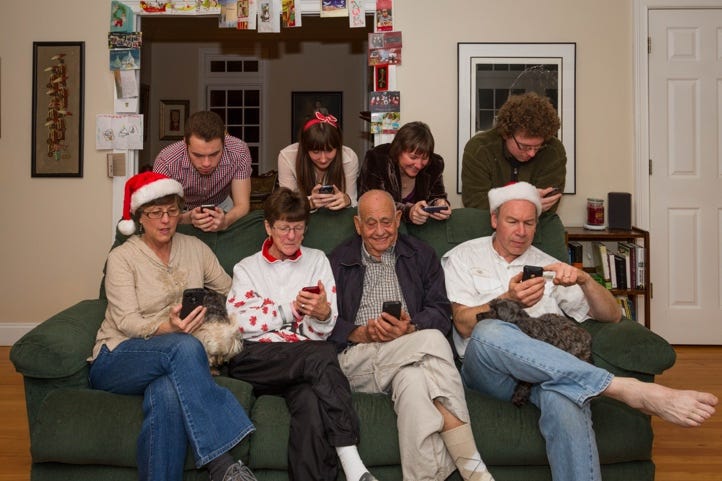
I would love to hear your thoughts about technology and where you experience it on Maslow’s Hierarchy of needs.
And don’t worry, I’m still in therapy.